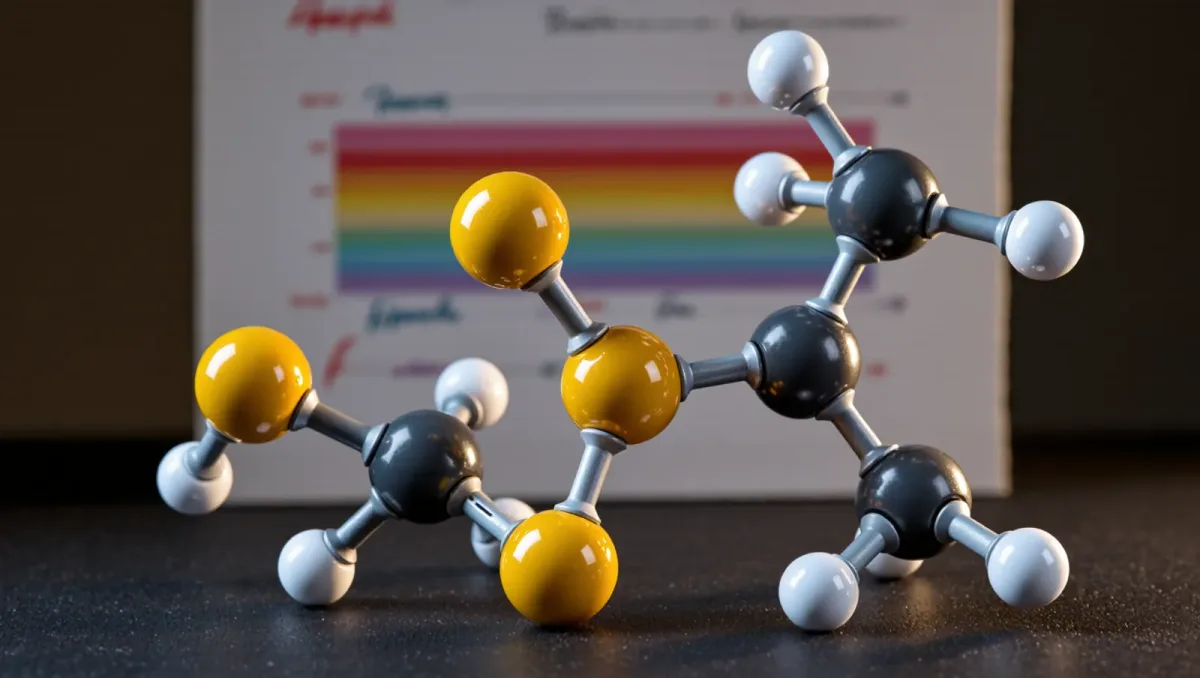
Radio astronomers have detected the largest organosulfur molecule ever found in interstellar space, per a study published in Nature Astronomy on January 23, 2026. The molecule was identified in the molecular cloud G+0.693-0.027, a chemically rich cloud near the center of the Milky Way that has become the standard hunting ground for complex prebiotic molecules. Sulfur chemistry matters to origins-of-life research because sulfur sits in the same family of biologically essential elements as carbon, oxygen, and nitrogen — and because interstellar sulfur has long shown up dimmer than models say it should.
How do you find a molecule light-years away?
Molecules rotate, and rotating molecules emit radio waves at precise frequencies — a fingerprint of sharp lines at characteristic wavelengths. Astronomers point instruments such as the IRAM 30-meter telescope in Spain at a cloud, record the spectrum, and match the pattern of lines against laboratory measurements of candidate molecules. Detection claims require many matching lines at the right relative intensities, which is what protects the field from false positives; the Nature Astronomy paper's claim rests on that multi-line match, per the study.
Why the missing-sulfur problem matters
Models of interstellar chemistry predict far more sulfur in molecular clouds than observations account for. One proposed solution: sulfur locks into molecules and solid grains that standard surveys miss. Each new sulfur-bearing organic detection supports that picture, showing sulfur participating in growing complexity — thioaldehydes, thiols, and now heavier organosulfur species — rather than vanishing. The new molecule is the heaviest of its class found so far, extending the chain of complexity chemists can verify in space.
Is this a sign of life?
No, and the distinction matters. Interstellar chemistry builds complexity abiotically: radiation and cold surfaces assemble molecules without biology. The relevance to life is as feedstock — complex organics formed in clouds may seed planets, where they become raw material for prebiotic chemistry. The G+0.693 cloud is extreme even among molecular clouds, close to the galactic center where conditions differ from ordinary star-forming regions like those where the Sun formed, so its chemistry may overrepresent what ordinary clouds can do.
What would strengthen the finding?
Detection of the same molecule in a second, chemically ordinary cloud, and confirmation by an independent team with different instrumentation, are the standard next steps. The broader test is the sulfur budget itself: if grain chemistry and these detections add up, the missing-sulfur problem closes; if not, models need revising. Either outcome would be recorded one line at a time in the radio spectrum.