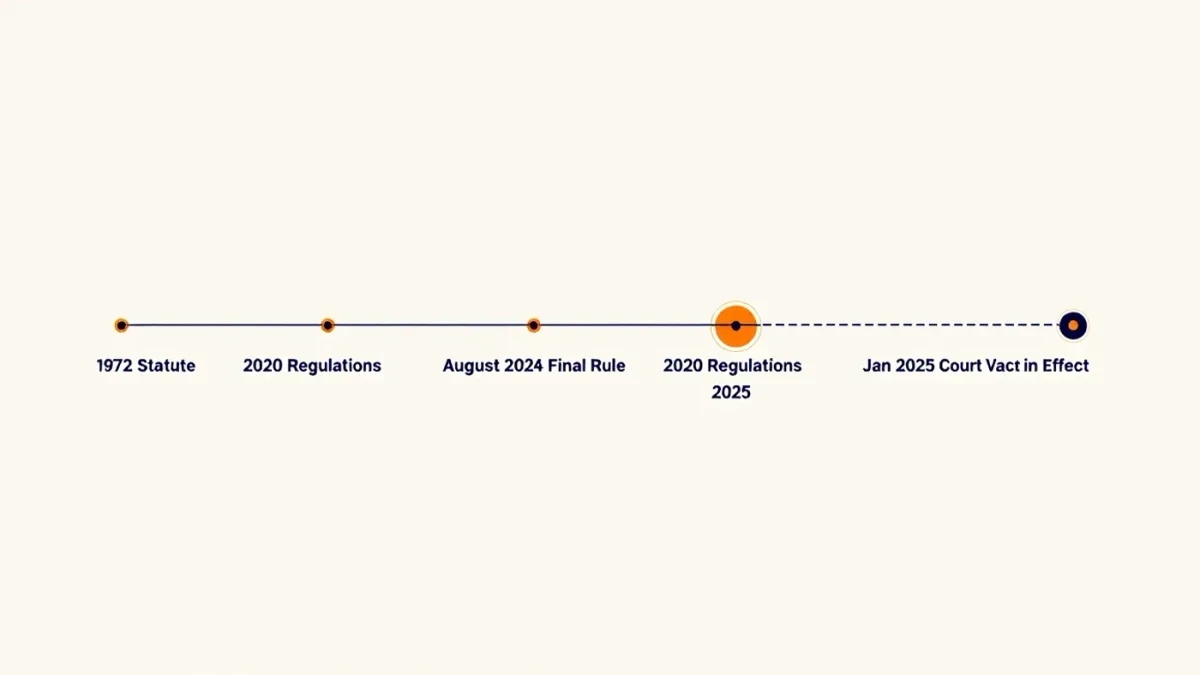
By mid-2025, American universities had dismantled or renamed more diversity, equity and inclusion infrastructure than in any comparable period in the modern history of academic administration. The sequence ran in two waves. First, state law: beginning with Florida and Texas — Texas Senate Bill 17, effective January 2024, closed university DEI offices statewide — more than a dozen states restricted DEI programming or staffing in public institutions. Then, the federal wave: on January 20, 2025, an executive order revoked the six-decade-old Executive Order 11246 and directed agencies to end DEI-related grant conditions; on February 14, 2025, the Department of Education sent a Dear Colleague letter interpreting the Supreme Court's 2023 admissions ruling expansively and warning of Title VI enforcement against race-conscious programming; and a February 28 deadline required institutions to certify compliance. Litigation followed within weeks, with federal courts in New Hampshire and Maryland blocking parts of the enforcement campaign in April 2025 while universities audited themselves anyway.
This is a policy explainer, not legal advice; institutions facing enforcement should consult counsel.
What concretely disappeared or changed?
The visible changes fall into patterns, documented by university announcements and education-press tracking through 2025. Offices closed: DEI divisions at public universities in banned states were dissolved outright, with staff reassigned or dismissed. Jobs were retitled: vice presidents for diversity became chiefs of staff or vice provosts for 'community and belonging' — same portfolios, new letterheads, at institutions far beyond the banned states. Programs were restructured: race-specific scholarships, mentoring programs and summer programs were opened to all students, sometimes under court or agency pressure, sometimes preemptively. Training requirements were dropped or rewritten. And language moved: course catalogs and strategic plans scrubbed the phrase 'diversity, equity and inclusion' faster than statutes required, an anticipatory conformity that researchers of organizational behavior noted had its own history in earlier political cycles.
Where did the DEI apparatus come from in the first place?
The infrastructure being dismantled was itself a historical artifact, built in identifiable layers. The first diversity officers emerged from civil-rights-era compliance offices — equal-opportunity mandates required somebody to keep the paperwork. A second layer followed the 1978 Bakke decision, which barred quotas but preserved diversity as a constitutional rationale for selective admissions and, with it, a professionalized admissions diversity role. The third and largest expansion came after 2015: campus activism, corporate analogy, and wealth from the bull market funded a wave of vice provosts, strategic plans and mandatory trainings. Each layer added staff faster than the last, and by 2023 a handful of large systems employed hundreds of DEI-classified personnel — counts that political opponents compiled into databases, and that supporters defended as small fractions of administrative headcount. Understanding that the apparatus was layered, not monolithic, explains why its dismantling is also uneven: the statutory compliance core cannot be abolished, while the 2015-era layer is precisely what the bans target.
What remained standing?
More than either side's rhetoric suggested. The Supreme Court's 2023 Students for Fair Admissions decision barred race in admissions decisions but explicitly preserved recruitment pipelines, essays discussing identity, and race-neutral diversification strategies — and most private universities kept identity-based cultural centers and student groups, which the federal letters did not directly command them to close. Federal law still requires Title IX offices, disability accommodation, and anti-discrimination compliance; several universities argued, in litigation filings, that the Dear Colleague letter misread the statute they were accused of violating. The April 2025 injunctions rested on that argument: judges found the education department had likely overstepped by attaching vague conditions to funding without proper procedure. The practical result through 2025 was a patchwork — constrained everywhere, dismantled in some places, untouched in others, with litigation unresolved.
How did universities' own behavior split?
Along predictable lines, with notable exceptions. Most public universities in ban-states complied fully. Wealthy private universities faced the federal campaign's sharpest test — the administration's spring 2025 dispute with Harvard over funding and governance became the emblematic confrontation, with billions in grants frozen and litigation filed — while other institutions, dependent on federal research money, chose accommodation: renaming offices, canceling conferences on DEI themes, and softening public messaging without formal program closures. Higher-education associations documented the variance and warned against compliance with conditions they called legally defective. The split revealed a market: institutional risk tolerance tracked endowment depth and revenue diversity more closely than mission statements.
What does the evidence say about what DEI programs did?
This is where the policy debate outran the research in both directions. Meta-analyses of diversity training in organizations — the best-studied lever — find modest, short-lived effects on attitudes and weak evidence of behavior change; the strongest documented effects in higher education concern pipeline outcomes like graduation-rate gaps, where multi-institution studies associate structured support programs with retention gains, though causal identification is difficult and the programs defy easy generalization. Claims that DEI offices caused institutional decline, or that their abolition will, both lack strong evidence. What the 2023-2025 period demonstrably produced is natural experiments: states with bans and states without, universities that renamed and universities that did not — datasets that researchers began assembling in 2025 and whose results will take years.
What should an observer watch next?
Three markers: the outcome of the funding-freeze litigation, which will define how much condition-setting on federal grants any administration may do; accreditation standards, where the federal push against DEI ran into existing diversity expectations and forced revision fights; and the quiet test of renamed offices — whether 'belonging' portfolios preserve staff and programs or whether the rebrand marks attrition. The structural story is easier to state than the outcome: the DEI apparatus built between 2015 and 2023 met a coordinated political reversal in 2023-2025, and by mid-2026 the sector's diversity infrastructure is smaller, quieter and differently named. What survives the courtrooms and the budget cycles will define the next era.