No other professional apprenticeship concentrates so much power in one relationship. A doctoral student's stipend flows from the advisor's grants, the dissertation topic usually grows from the advisor's program, authorship positions on papers follow the advisor's judgment, the timeline follows the advisor's expectations, and the letters that decide the next job are written by the advisor alone. Roughly four in ten students who begin a PhD in the United States leave without completing it — the Council of Graduate Schools' multi-institution completion project found only about 57 percent finish within ten years — and exit interviews and surveys consistently place the advising relationship among the most-cited reasons. The mechanics of that relationship, not its psychology alone, explain both the risk and the reforms now spreading through graduate education.
This is an explainer on doctoral-education structures, not advice for any individual situation.
What exactly does the advisor control?
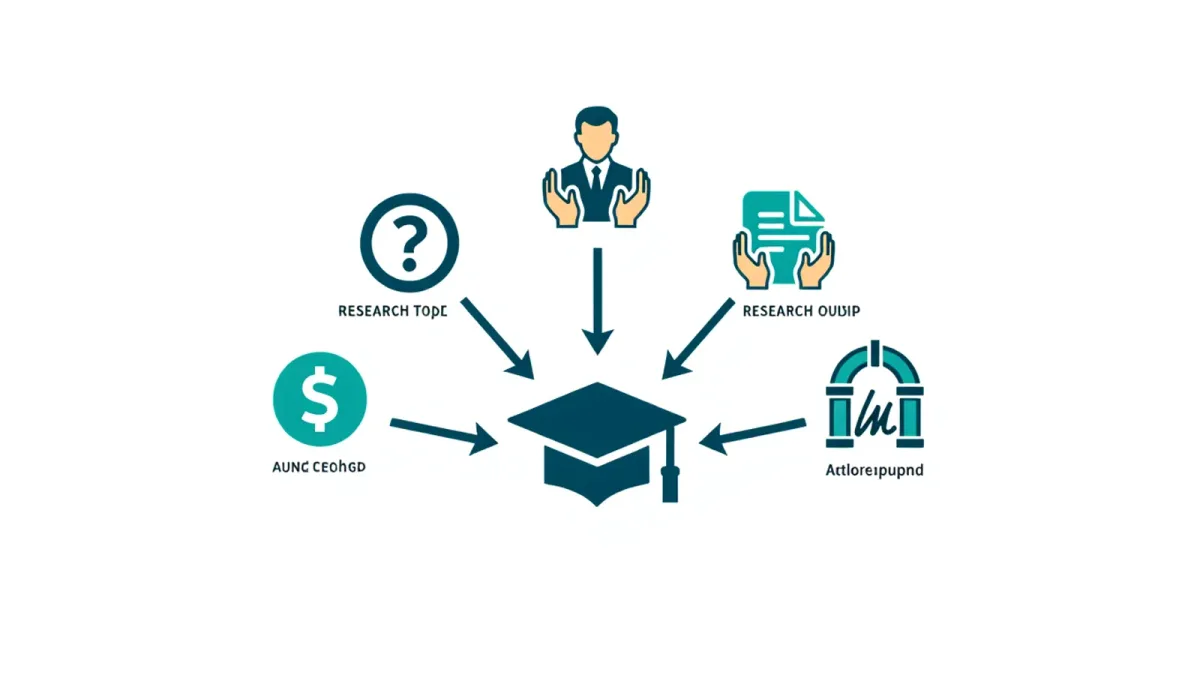
Four levers, formally and informally. Money: most science and engineering students are funded through research assistantships on advisor-held grants, so continued funding is the advisor's decision renewing annually. Topic and method: the advisor's program defines what questions are affordable, publishable and defensible. Credit: authorship conventions in most fields leave first-authorship and inclusion entirely to the advisor's discretion, and disputes rarely have formal remedy. Gatekeeping: only the advisor signs off that a dissertation is ready to defend, and only the advisor's letters carry real weight afterward — a dependency that extends past graduation. Committees exist to check this power, but they convene rarely, depend on the advisor's scheduling, and rarely intervene in the relationship's daily economics.
What does the evidence say about why students leave?
The strongest data come from longitudinal, multi-institution studies rather than exit surveys of single departments. The Council of Graduate Schools' completion project tracked tens of thousands of doctoral students and found attrition near 40-45 percent, highest in the first two years, with funding adequacy, mentoring quality and program fit as recurring self-reported factors. Studies of mentoring quality — including the National Academies' 2018 review of graduate STEM education — consistently associate structured mentorship with faster completion and better post-degree outcomes, while surveys of doctoral mental health, most prominently a 2017-2018 study of PhD students in Belgium by Katia Levecque and colleagues, found that one in three respondents was at risk of a common psychiatric disorder, with work-family conflict and poor supervisor relationships among the strongest correlates. The causal picture is harder than the correlational one — students who conflict with advisors also face other pressures — but the concentration of reported causes is replicated across countries and fields.
Is one advisor per student the only model?
No, and the alternatives have a track record. European doctoral schools frequently assign multiple supervisors with distinct roles. Lab rotations in the first year, standard in biomedical programs, delay the match until both sides know each other. Co-advising pairs a content expert with a methods expert and deliberately splits the dependency. What all three models trade away is efficiency: a single devoted advisor invests more per student, and dispersing the relationship disperses that investment. The structural insight is that the American single-advisor model optimizes for research productivity, and its documented costs — attrition, delayed completion, mentor dependence — are the externalities of that optimization rather than accidents.
What reforms are actually in motion?
Three have teeth. Written expectations: mentoring compacts — documents specifying meeting frequency, authorship norms, funding duration and conflict processes — are now required or encouraged at many universities, and federal funders moved too: NSF requires postdoc mentoring plans in qualifying proposals and has extended the requirement's reach across its portfolio. Mentoring training: teaching professors to supervise, on the model of clinical supervision training, is now offered at a majority of research universities. Third-party channels: ombuds offices, graduate-student advocates and annual committee reviews that do not include the advisor give students somewhere to raise disputes without litigating their own future. None of these removes the core dependency; each documents it, which changes what the dependency can silently do.
Why is the problem so hard to fix institutionally?
Because every safeguard conflicts with something the system also values. Annual committee reviews cost faculty time and blur the advisor's authority over their own grants' work. Mentoring compacts without enforcement reduce to decor. Moving students between labs mid-degree — the obvious remedy for a broken match — disrupts research continuity and asks someone to absorb a student trained in someone else's project. Universities also face a measurement problem: advising quality shows up in attrition rates and completion times that surface years late, while its failures stay private because students who antagonize an advisor risk the letters that decide their careers. This is why the reform literature converges on documentation rather than punishment — records, compacts, third-party channels — as the realistic intervention set: they raise the cost of bad mentoring without requiring anyone to adjudicate a professor's judgment in real time.
How should a prospective student read a program?
Ask how funding is guaranteed if an advisor's grant lapses — teaching lines versus hard commitments. Ask how many advisees the target advisor currently has, and where recent ones landed. Ask whether the program uses compacts and what happens when one is violated. The answers are checkable before acceptance, and they predict the relationship better than either the advisor's charisma on a visit or the program's ranking. The dissertation has always been a research project; the evidence of the last decade says it is equally a management arrangement, and the arrangements — unlike genius — can be designed.