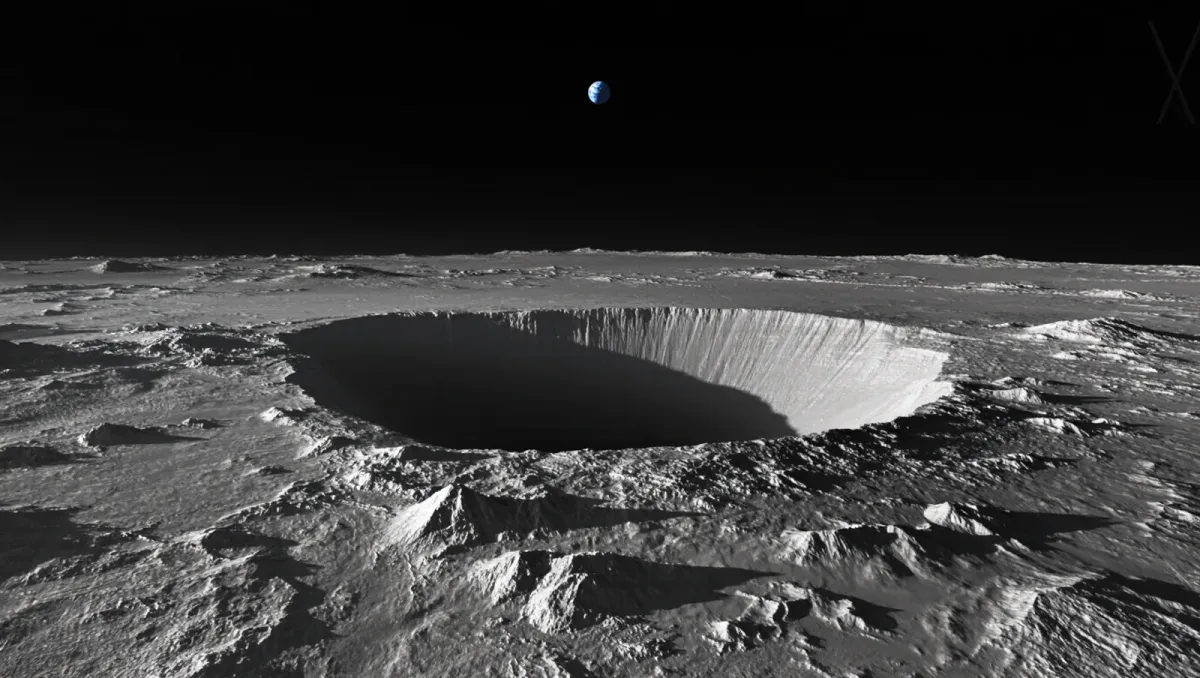
Radar aboard India's Chandrayaan-2 orbiter has detected evidence of water ice inside doubly shadowed craters at the lunar south pole, per a study published May 6, 2026 in the journal npj Space Exploration. The finding matters for a plain logistical reason: water ice on the Moon is drinking water, oxygen, and rocket propellant in raw form, and the craters near the lunar south pole are the coldest measured places in the solar system — cold enough to trap ice for billions of years.
Space-resource claims are research findings, not predictions about mission economics; those depend on engineering and policy decisions still pending.
Why radar, and why these craters?
The south-polar craters are permanently shadowed — sunlight never reaches their floors — so optical cameras see nothing inside them. Radar sees differently: ice reflects radio waves with a distinctive polarization signature that rough rock does not imitate well. Chandrayaan-2's dual-frequency synthetic aperture radar could distinguish the dielectric properties of surface material, and the study reports ice-consistent signatures concentrated in craters whose floors are both shadowed from the sun and shadowed from Earth's radio 'illumination' — the doubly shadowed sites where surface ice is least disturbed, per the paper.
How does this fit earlier ice evidence?
The case for lunar ice has accumulated across instruments: the 2009 LCROSS impact threw up a plume containing water vapor, neutron spectrometers on Lunar Prospector and later orbiters mapped hydrogen enhancement at the poles, and thermal models identified cold traps stable over geological time. What each technique shows differently is depth and form — neutron data sense hydrogen to a meter down, radar senses near-surface ice patches, and the new study's contribution is mapping where those overlap at fine resolution inside individual craters. Per the study, the radar-detected deposits correspond with the coldest model-predicted traps.
What the finding does not settle
Radar signatures are consistent with ice, not a chemical assay. Concentration, purity, and layering remain open — a crater floor could hold patchy frost centimeters thick or regolith laced at low percentages, with very different consequences for any future extraction. Definitive answers require in-place measurement, which is exactly what NASA's Volatiles Investigating Polar Exploration Rover and subsequent landed missions are designed to deliver.
What would confirm the finding?
Landed instruments drilling and heating polar regolith to measure water content directly, and independent radar reobservation of the same craters. The south pole is now the most contested real estate off Earth for precisely this reason: if the ice is as concentrated as the radar suggests, the first sustained lunar presence will be built wherever it pools.