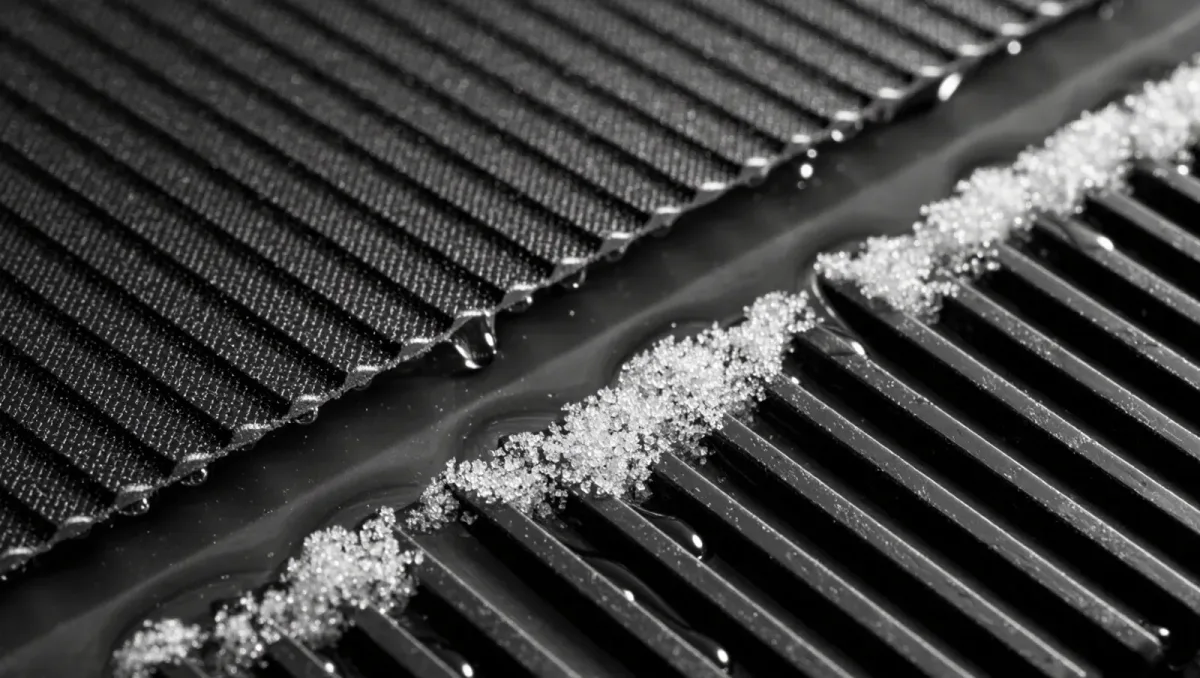
Researchers report a solar desalination surface that evaporates saltwater while leaving no liquid brine discharge — the salt crystallizes on the material itself and can be harvested as a product, per a study published May 27, 2026 in the journal Light: Science & Applications. The surface, made by laser-etching an aluminum sheet into a dense forest of microscopic grooves, wicks water upward against gravity through capillary action while sunlight heats the thin film spreading across it. The team calls the property superwicking, the companion to the superhydrophobic surfaces their laboratory at the University of Rochester is known for.
Desalination performance figures are laboratory results; scaling to municipal supply involves costs and infrastructure this study does not address.
What is new compared with existing desalination?
Conventional reverse-osmosis plants push seawater through membranes and discharge a concentrated brine that can harm coastal ecosystems, and they run on electricity or pressure infrastructure. Solar evaporation approaches eliminate the energy problem but have historically failed on the salt problem: as water evaporates, salt accumulates on the evaporation surface, clogging it within hours. The reported design handles salt by engineering the flow — capillary channels continuously feed water through the structure so crystallization happens in designed collection zones rather than across the evaporating surface, and the study reports continuous operation with the salt harvested as solid residue rather than returned to the sea, per the paper.
How well did it perform?
Per the study, the surface achieved evaporation rates at the high end of solar absorber designs while remaining salt-free during extended operation, in laboratory tests with artificial seawater at concentrations exceeding ocean salinity. The physics that makes it work: laser texturing creates hierarchical micro- and nanoscale grooves that pin a water film only micrometers thick, so nearly all absorbed sunlight goes into vaporizing water at the surface rather than heating bulk liquid.
Who is this for?
The realistic near-term use is small-scale and off-grid: coastal and island communities, disaster response, and agricultural settings where grid-powered desalination is unavailable and brine disposal is prohibited. The co-product angle matters in arid regions, where the harvested salt offsets some cost. Community-scale trials, not laboratory beakers, are the necessary next step, and the energy math that looks elegant per square meter must survive dust, waves, and years of outdoor exposure.
What would confirm the finding?
Independent replication of the zero-brine claim at realistic scale, and durability data showing the laser-etched structure survives fouling and wear outdoors. If both hold, the design joins a short list of solar evaporation approaches that solve salt accumulation structurally rather than by periodic cleaning — which has been the field's recurring disappointment.