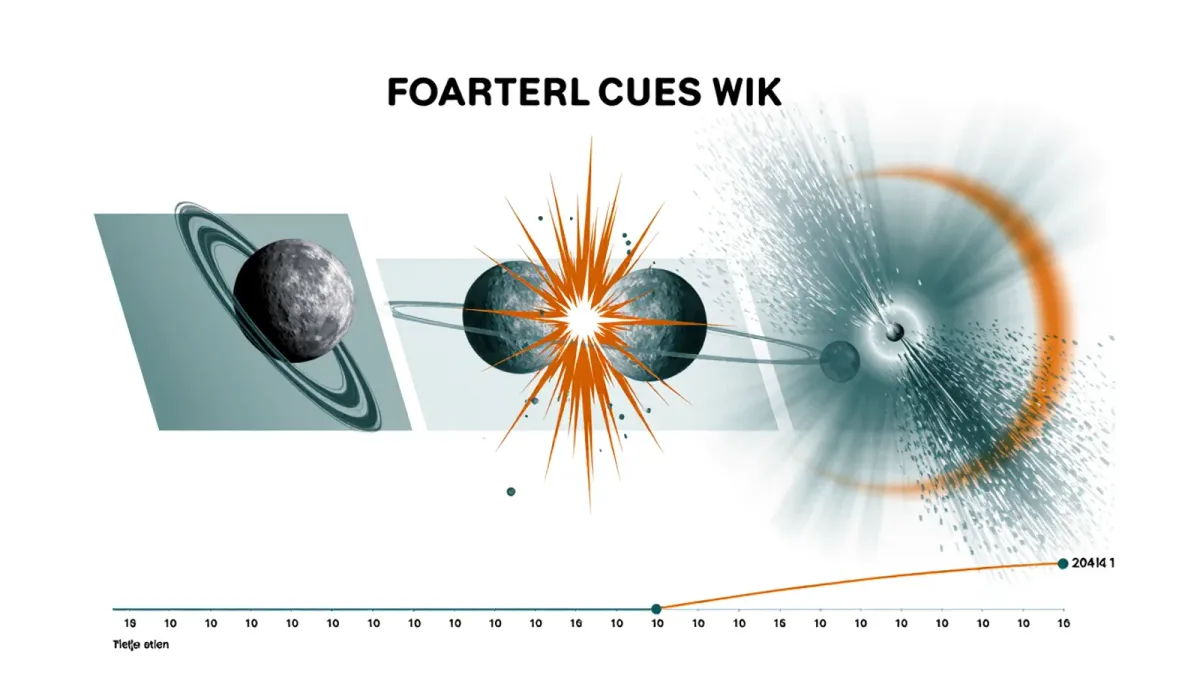
Astronomers at the University of Washington report evidence that a planet-scale collision occurred around the young star Gaia20ehk, per the team's March 11, 2026 announcement. The star, monitored for years by ground-based surveys, brightened dramatically in infrared light over months — the pattern expected when two rocky bodies collide and vaporize, sending a cloud of hot dust and molten debris into orbit that then glows and slowly cools. It is the strongest real-time observation yet of the kind of impact thought to have shaped our own solar system, including the giant impact believed to have formed Earth's Moon.
How do you detect a crash that happened light-years away?
Not by seeing the impact directly — the star system is too distant for that. Instead, astronomers watch for a thermal afterglow: collisions release enormous energy, and the debris cloud absorbs and re-emits starlight in infrared, where it outshines the star's normal output. Survey instruments flagged Gaia20ehk's infrared rise, and follow-up observations tracked the glow's temperature and brightness over time. The physics resembles a scaled-up version of what planetary scientists reconstruct from crater records: an impact big enough to melt rock has a distinct, calculable signature.
Why collisions matter in planet formation
Planets grow violently. Dust grains stick into pebbles, pebbles into planetesimals, and the final assembly involves giant impacts between Moon-to-Earth-sized bodies. The Moon is the textbook case: the leading model holds that a Mars-sized body struck the young Earth about 4.5 billion years ago, and the debris coalesced into our satellite. Catching an equivalent event around a young star — Gaia20ehk is still in its planet-forming era — turns a reconstruction exercise into live observation.
How confident is the interpretation?
Reasonably, but not conclusively. Alternative explanations for infrared outbursts exist, including stellar activity or dust production by ordinary processes, and the Washington team's case rests on matching the glow's evolution to impact models, per their announcement. The decisive test is time: an impact debris cloud should cool and disperse on a predictable schedule over years. Continued monitoring of Gaia20ehk, which the team said is underway, will either match the forecast or force a different explanation — a rare case in astronomy where the next act is already scheduled.
What would confirm the finding?
Spectroscopy identifying vaporized rock species in the debris, and the expected fade of infrared emission on model timescales. If both hold, Gaia20ehk becomes the clearest recorded example of giant-impact planet formation, and a calibration point for every model of how rocky worlds — including Earth — are assembled.