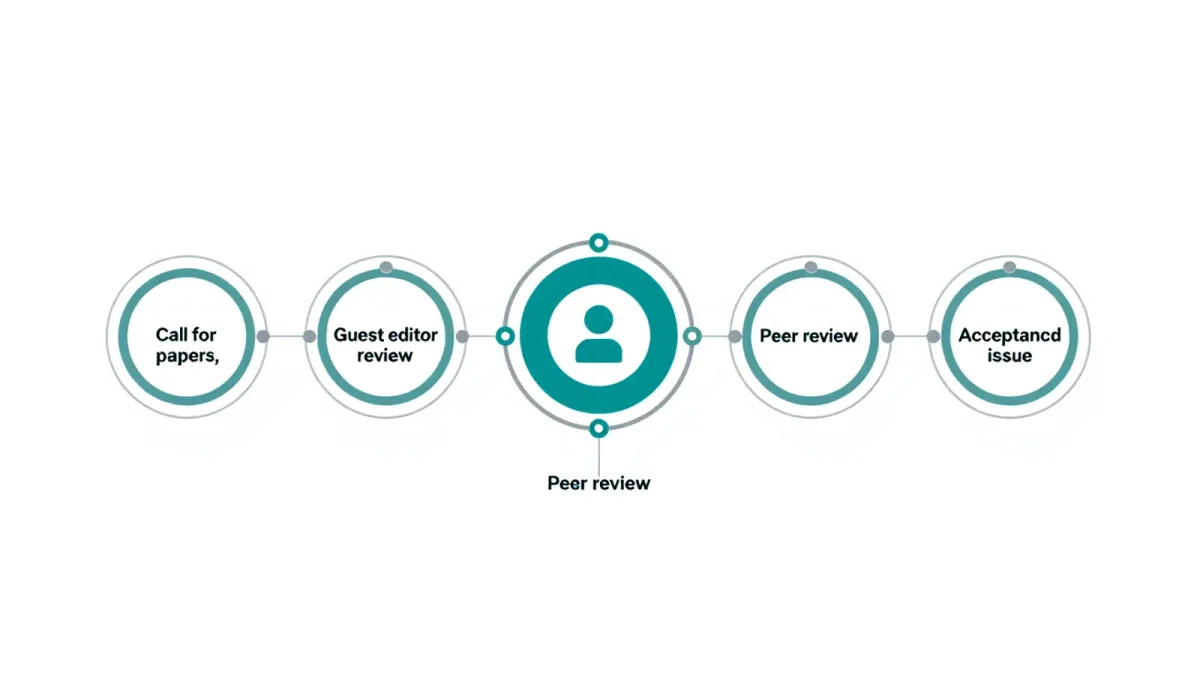
Registered reports flip the usual order of publishing. Instead of submitting a finished paper and waiting to learn whether the results were impressive enough, researchers submit their question, design, and analysis plan first. Reviewers judge the plan. If it passes, the journal commits in principle to publish whatever the data end up saying. Adoption has been steady if uneven: as of 2025, the community-maintained registry at the Center for Open Science listed more than 300 journals offering the format, concentrated in psychology and increasingly visible in neuroscience, medicine, and ecology.
This is an explainer on how the format works; research teams should still check each journal's current policies before submitting.
What problem is the format built to fix?
Conventional peer review sees results first, and reviewers know that positive, novel findings feel more publishable. That incentive feeds two documented failures. Publication bias means studies that find nothing often never appear, so the published record overstates effects. And analytic flexibility — trying subgroups, switching outcomes, adding exclusions until a p-value crosses 0.05 — is easy to hide in a finished manuscript. Large replications of psychology experiments in the 2010s, including the Open Science Collaboration's 2015 effort that replicated well under half of 100 cited findings, turned these concerns into a field-wide reform movement. Registered reports attack both problems at once: the paper is accepted before there is anything exciting to report, and the analysis plan is fixed while there is still no temptation to bend it.
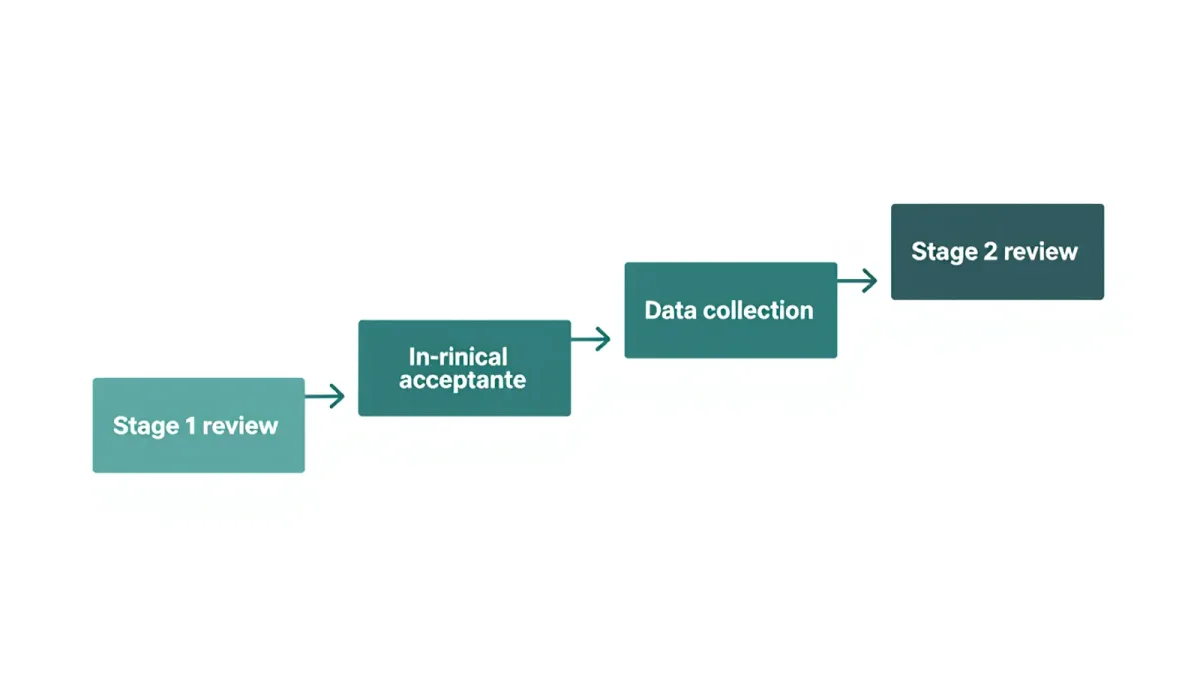
How does the two-stage process run?
Stage one is a proposal: rationale, hypotheses, methods, power calculations, and an analysis plan precise enough that a stranger could execute it. Reviewers assess whether the study is worth doing and designed well. Acceptance at stage one yields an in-principle acceptance — a commitment the journal publishes regardless of outcome, contingent only on the authors following the approved protocol. Stage two happens after data collection. Reviewers check that the authors did what they said, and that interpretations match the results, not whether the effect "worked." Results sections can report surprises as exploratory, clearly labeled.
Where is it used, and who offers it?
Psychology led: Cognitive Affective & Behavioral Neuroscience and Comprehensive Results in Social Psychology were early adopters in the mid-2010s, and flagship outlets including Nature Human Behaviour added registered-report tracks. Medical journals followed more slowly, deterred by ethics approvals and clinical-trials infrastructure that already occupies similar ground. In 2020, COVID-19 accelerator programs used the format to triage protocols fast. The Center for Open Science maintains the canonical list of participating journals, and several funders, including the European Research Council, now allow grant applicants to cite in-principle acceptances as evidence of feasibility.
What are the limits?
The format demands that authors predict their analysis before seeing data — unrealistic for genuinely exploratory work, which is why registered reports suit confirmatory questions best. Reviewing a protocol is also harder than reviewing a finished paper: predicting whether a measurement will work requires methodological judgment rather than an eye for results. Authors report longer timelines, since review happens twice. And the commitment is only as strong as the journal; a handful of early in-principle acceptances lapsed when journals retracted or editors changed, which reformers treat as an integrity test the system mostly passes but not automatically.
Does it improve the science?
Direct evidence is still accumulating. Analyses of published registered reports find far higher rates of null results than conventional papers in the same journals — consistent with the format removing publication bias, though also explicable by differences in what gets submitted. A 2023 meta-analysis in psychology found registered reports showed lower evidence of undisclosed analytic flexibility. Nobody has yet demonstrated that the format accelerates discovery; the claim it supports is narrower — that it makes the published record more faithful to what was actually found.
What do reviewers actually check at stage one?
The stage-one review reads nothing like a normal manuscript review, because there are no results to assess. Reviewers judge whether the hypothesis is worth testing, whether the design can answer it, whether the sample size gives the study adequate statistical power, and whether the analysis plan is specific enough that judgment calls cannot be made retroactively. A vague plan, such as promising to compare groups with appropriate tests, fails; a complete plan names the primary outcome, the exclusion criteria fixed in advance, and the exact models. The most common stage-one revisions concern power: reviewers routinely push for larger samples than authors proposed, which is arguably the format's quiet methodological contribution, since conventional review rarely sees or fixes a power problem before data collection begins.
How does the format relate to preregistration and preprints?
Three tools get conflated. Preregistration, posting a study plan on a public registry before data collection, commits authors publicly but involves no peer review and no publication commitment. Registered reports add review and commitment. Preprints are the mirror image: full results published early, with no prior commitment about what would count as a finding. The tools compose: a registered report's stage-one protocol can be posted publicly, and the final paper can appear as a preprint after stage-two acceptance. What they cannot do is substitute for one another, though author surveys find researchers routinely describing preregistration in terms that sound like registered reports, evidence that the distinctions still need spelling out several years into the reform wave.
What would confirm or overturn the case?
The decisive test would be paired cohorts: similar studies run as registered reports versus conventional submissions in the same field, tracked for replication success. Until such data mature, the honest position is that registered reports solve a real, measured problem with a structural fix, at a cost in speed and flexibility that not every project should pay.