A special issue is a themed collection of papers run by a guest editor — usually a specialist recruited by the journal — who solicits contributions, manages review, and presents the batch as a coherent whole. Done well, the format works: special issues on fast-moving topics, from CRISPR base editing to large language models, assemble expertise faster than a journal's standing editorial board could. Done badly, the format became the single largest fraud vector in modern publishing. The 2021-2024 wave of mass retractions hit hardest in guest-edited special issues: thousands of papers were pulled after paper mills compromised guest editors or manufactured entire issues, and major publishers retracted them by the hundred.
This is an explainer on the mechanics and risks of special issues; authors considering a guest invitation should verify the journal directly.
How is a special issue supposed to run?
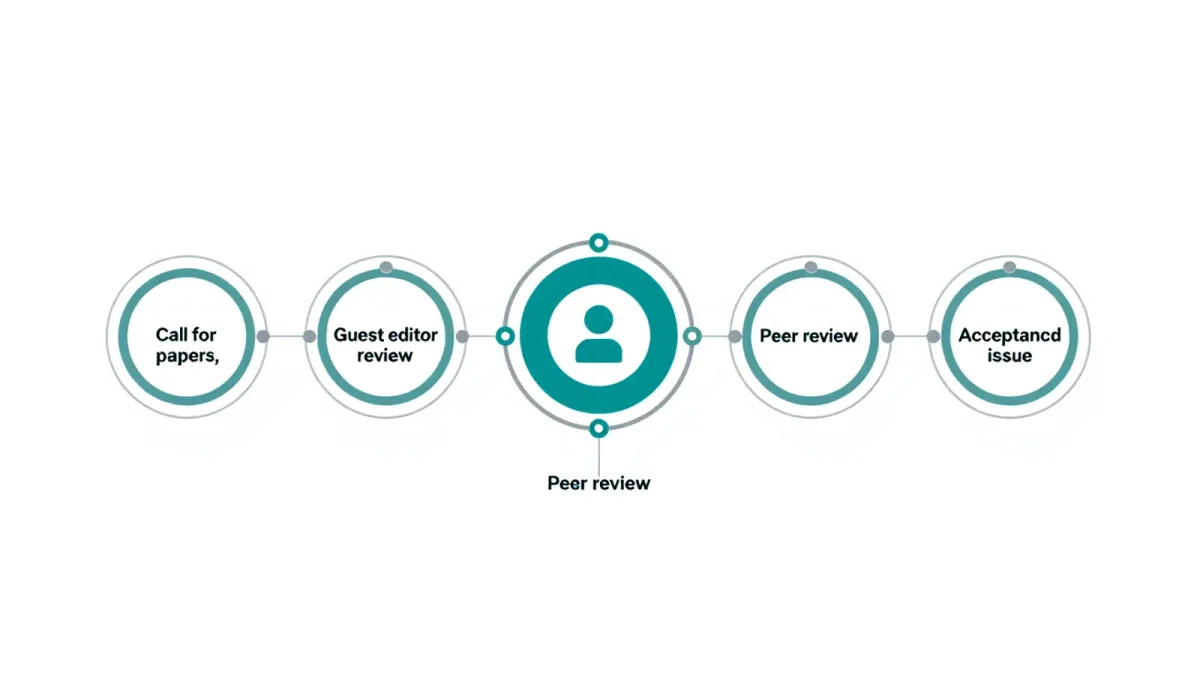
The standard pipeline: the journal approves a proposal from a guest editor — typically a leading specialist — who writes a call for papers, recruits submissions through their network, and assigns reviewers, normally with the journal's regular editorial office checking the process. Papers pass the same peer review as regular submissions, and the journal retains final acceptance authority. The value comes from curation: a guest editor knows which questions matter and which labs can answer them, so the issue arrives as a snapshot of a field rather than a random sample.
Why did the format become a fraud target?
Because the gatekeeper is one person. A paper mill that compromises a guest editor — or impersonates one, in documented cases where fake editor accounts were created with AI-generated profiles — acquires a pipeline into an indexed journal under a trusted brand. The pattern repeated across publishers: once inserted, the guest editor or their accomplices accepted mill papers in bulk, sometimes dozens per issue, bypassing review entirely. Investigations tracked by Retraction Watch and publisher integrity teams found hijacked special issues producing on the order of tens of thousands of suspect articles cumulatively by 2024, prompting publishers including Elsevier to retract entire special issues and build screening for them specifically.
What defenses now exist?
Publishers formalized checks that were once informal: verifying guest editors' identities institutionally, requiring the journal's own editors to approve every review assignment in a special issue, capping how many papers one guest editor can shepherd, and screening submissions for mill markers — stock-phrased introductions, reference-list anomalies, image duplication. COPE's guidance and publisher policies now explicitly cover guest-editor misconduct. The economics explain why defenses arrived late: a special issue that fills quickly looks like success in every metric a journal tracks, until someone reads the papers.
How are guest editors vetted now?
The vetting that was once a courtesy email has hardened into procedure at large publishers. Current practice at major houses includes verifying the candidate's affiliation and publication record through institutional channels, checking whether the proposed topic overlaps with issues the candidate already runs elsewhere, limiting how many special issues one person can run simultaneously across a publisher's portfolio, and in higher-risk fields, requiring the journal's own editors to approve every reviewer assignment within the issue. Some publishers now run identity checks after documented cases of fabricated guest editors: professional-looking profiles, sometimes with AI-generated photographs and composed career histories, attached to invented email domains one character away from a real institution's. The screening burden falls on journals that historically budgeted nothing for it, which is why implementation varies widely and why smaller society journals remain the most exposed part of the system.
What do authors gain from a well-run special issue?
Visibility, mostly, and a defensible reading of the format's value. Papers in a curated collection cite one another and get read together, so each article inherits the issue's framing and audience; editors of successful issues report citation and download patterns above the journal's baseline for ordinary issues. For early-career authors, guest editors who are genuine field leaders also become contacts, and reviewing for a special issue is a standard service role on a manageable scale. The counterweight is reputational: a paper published in a later-retracted issue inherits the taint in database records and hiring-committee searches, which is why integrity researchers advise authors to weigh the guest editor's identity as carefully as the journal's brand. Both halves of that calculus depend on the same fact the fraud wave exposed — the guest editor is the institution, for better and for worse.
Should authors accept guest-editing invitations?
The invitation itself deserves scrutiny, since impersonation works in both directions — researchers also receive fake journal calls that borrow real special-issue branding. Verification steps that work: confirm the journal's special-issue listing on the publisher's own site, check that the guest editor is who they claim through institutional channels, and treat any issue promising rapid acceptance as the red flag it is. The format is not broken; it is concentrated, and concentration cuts both ways. The measurable test of the reforms: whether mass retractions tied to guest-edited issues decline over the next contract cycle — data publishers now publish voluntarily.