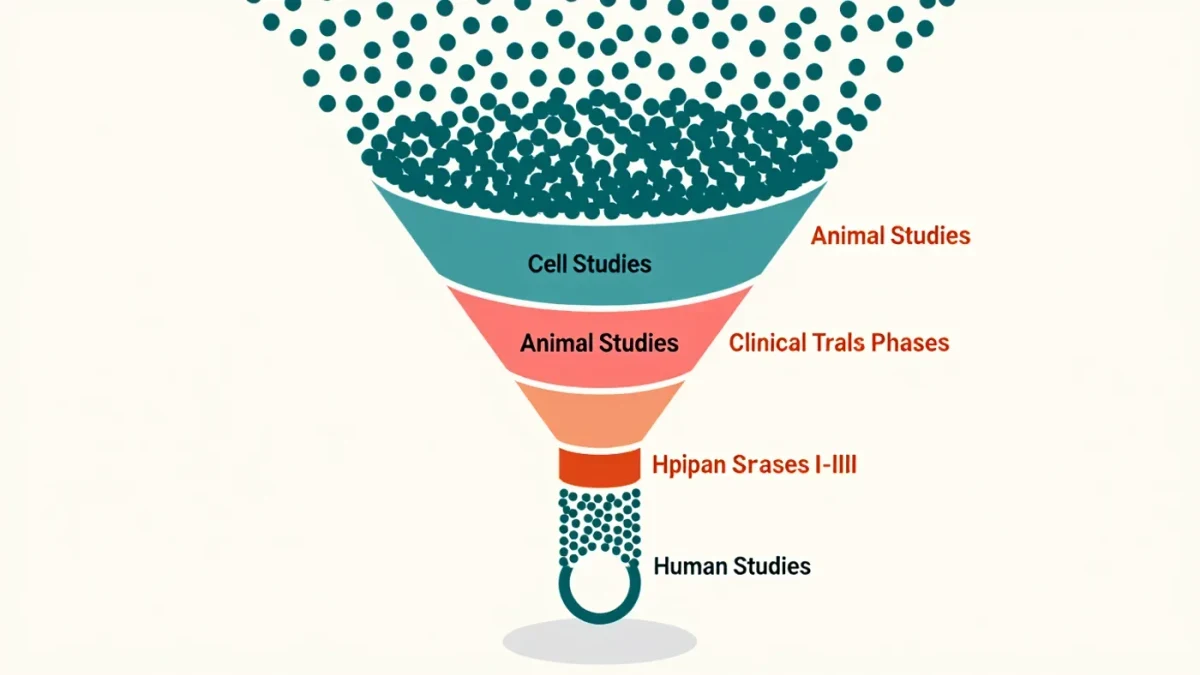
The phrase 'in mice' — deployed honestly in headlines after years of pressure — signals something specific: a result from a preclinical animal model, at the very start of the long pipeline toward human medicine. The pipeline is narrow. Reviews of clinical development consistently estimate that around 90 percent of drug candidates entering phase I human trials never reach approval, failing on safety or, more often, lack of efficacy. Since animal work is the foundation those human trials stand on, understanding why mouse results translate so imperfectly is understanding where most of the funnel's losses occur.
This is a methods explainer; nothing here should guide treatment decisions.
What limits mice as models of human disease?
Three limitations dominate. First, biology: mice and humans diverged tens of millions of years ago, and differences in immune systems, metabolism, lifespan and brain structure mean the same intervention can act differently across species — a mouse's two-year life compresses aging in ways that matter for chronic disease. Second, modeling: researchers rarely study naturally occurring disease; they create simplified approximations, like induced strokes in young, genetically uniform lab strains, and a treatment for a manufactured version of a disease need not treat the real thing. Third, diversity: most preclinical work uses young, male, inbred animals, while human patients are old, of both sexes, and genetically varied. Each limitation is individually documented; together they explain why a treatment can rescue mice reliably and fail humans just as reliably. None of this makes animal research pointless — it makes animal research a specific kind of evidence, whose value depends on how well the chosen model mirrors the human condition the researchers claim to be studying.
How much of the problem is the science itself?
A substantial share, and it is the part most fixable. A landmark 2012 analysis by Begley and Ellis, then at Amgen, reported that the company could reproduce the central findings of only 11 of 53 landmark preclinical cancer studies. Around the same time, researchers at Bayer reported similar trouble replicating target-validation studies. Papers in these analyses were peer-reviewed and high-profile; the failures pointed less at fraud than at weak design — unblinded outcome assessment, no randomization of animals to groups, small samples, and flexible statistics. The National Institutes of Health responded with formal rigor and reproducibility policy: grant applications since 2016 must explain how they will randomize, blind, estimate sample size, and consider sex as a biological variable. Training modules followed, and journals increasingly ask for the same checklist items at submission.
How strong is the evidence that design reform helps?
The case that blinding and randomization matter in animal research is well replicated. Meta-analyses in stroke research — notably the collaboration led by Malcolm Macleod, pooling hundreds of animal studies — found that studies reporting blinding and randomization reported smaller, more credible treatment effects, while unblinded studies inflated benefits by amounts large enough to explain failed translation. This is among the cleanest meta-science in the field because it happens study by study, not through self-report. What remains uncertain is whether the NIH-era reforms are shrinking the funnel's losses; the relevant outcomes — translation success rates — take years to observe, and honest assessments say the verdict is not yet in.
What happens after a mouse study looks promising?
The formal route runs through toxicology and pharmacology work in animals, experiments in human cells and tissues, then an investigational application to regulators before the first human dosing in a phase I safety trial. Phase II asks whether the drug has any signal of efficacy in patients, phase III whether that signal survives large, controlled comparison, and each stage filters out a different slice of candidates. Attrition is distributed across the whole path, but reviewers of the funnel consistently attribute the largest single share of late failures to efficacy — the drug simply does not do in patients what the preclinical evidence promised. That distribution is the shadow cast backward by imperfect animal models and weak preclinical design, which is why reform efforts aim upstream, at the animal studies themselves, rather than at the trials where the failures become public.
Why do promising animal findings still justify headlines?
Because they are genuinely informative — about plausibility. An animal result moves a hypothesis from 'conceivable' to 'testable,' which is a real and expensive step: it justifies toxicity work, human-cell experiments, and eventually a trial application. The error is in the audience's translation, not the science: a cured-mouse story is the beginning of evidence, roughly equivalent to a well-built case series in humans. Readers should expect a decade or more between such a finding and any approved therapy, with most candidates lost along the way — that timeline is the historical norm, not pessimism. The studies that survive this scrutiny intact are the ones worth watching; the rest are better read as early waypoints in a long, lossy process.
What would speed up honest translation?
More human-relevant preclinical models — organoids, humanized mice, better-aged and both-sex cohorts — and mandatory design standards that are already policy. Registries for animal studies, stronger data-sharing so methods can be checked before patients are exposed, and confirmatory replication in independent labs before trials launch would also raise the floor. The test to watch: whether phase II failure rates fall as rigor policies mature. If they do, the mouse-to-human gap will have been narrowed not by better headlines, but by better husbandry of evidence.