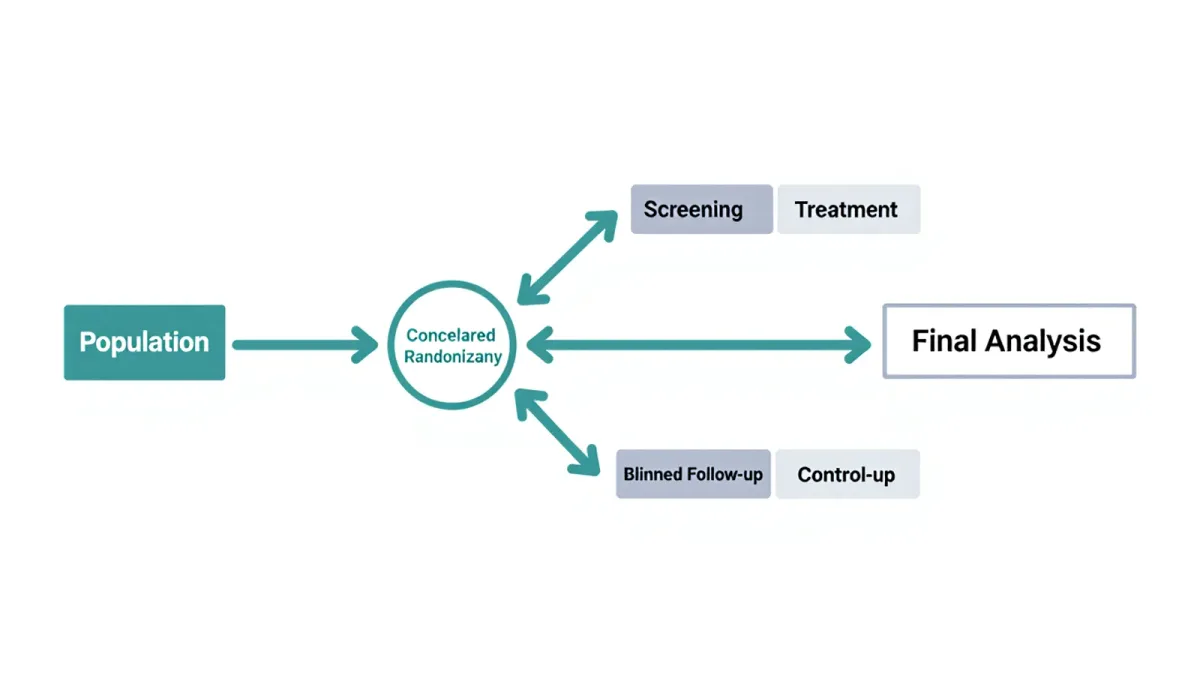
Every word in 'randomized, double-blind, placebo-controlled trial' names a distinct defense against a distinct way a study can fool itself. Randomization decides who gets the treatment by chance, so the groups start comparable. Blinding keeps participants and clinicians from knowing who got what, so expectations cannot become outcomes. The placebo control gives the blind something to maintain and measures the treatment's effect against expectation itself. None of the devices is mysterious; the trial's authority comes from stacking all of them, because each plugs a bias the others cannot catch.
This is a methods explainer; it does not evaluate any specific therapy.
What is the difference between randomization and allocation concealment?
Randomization is the sequence of assignments; concealment is keeping upcoming assignments unreadable until a patient is already enrolled. The distinction matters because clinicians and recruiters can, consciously or not, steer enrollment — holding back sicker patients until they see the next assignment is a treatment they prefer. Studies of trials have found that trials with inadequate concealment report systematically larger treatment effects than those with secure methods like sequentially numbered, opaque envelopes or centralized computer assignment. Concealment is a one-time gate at enrollment; blinding, by contrast, is a continuing condition throughout the study. Both are ranked separately in the risk-of-bias tools that guideline bodies use to grade trial quality.
Where does randomization come from?
The idea is younger than it feels. The modern randomized trial is usually dated to the 1948 Medical Research Council streptomycin trial for tuberculosis, though random assignment had precursors in agriculture in the 1920s and 1930s through Ronald Fisher's experiments, where flipping coins for plots was the only way to separate treatment effects from soil. Medicine borrowed the logic and, over decades, added the concealment protocols, registration norms and reporting standards described above. The history matters because it shows these devices were never self-evident: each was adopted after specific trials misled their contemporaries, and each can be traced to a particular bias it was invented to close.
Who is 'double-blind,' exactly?
Usually participants and the people interacting with them: the treating clinicians and the outcome assessors. A triple-blind trial adds the analysts or the data-monitoring committee. Each blinded party closes a specific channel: unblinded patients report outcomes through the lens of expectation — a real, measurable phenomenon, since placebo responses are genuine psychological and physiological events; unblinded clinicians titrate care differently and probe differently; unblinded assessors code ambiguous events toward the arm they expect. When blinding is impossible — surgery, physical therapy — trials fall back on blinded assessment, where independent evaluators who never meet the patient score the outcome videos or records. The bias this prevents is not hypothetical: meta-analyses of trial-design studies found that trials lacking double blinding exaggerate estimated effects by amounts comparable to real therapeutic gains.
How does a placebo do real scientific work?
A placebo is not a decoration; it is an active measurement instrument. Patients respond to the entire context of care — attention, ritual, expectation, side effects that unblind them — and those responses are genuine, involving measurable physiological pathways. A placebo arm converts the treatment's total effect into a difference against that background, which is the number that answers the clinical question. Placebos are also engineered to be believable: matching taste, color and side-effect profile, sometimes with an 'active placebo' that mimics a drug's harmless side effects so that guesswork stays suppressed. When the pill and the sham diverge in feel, unblinding sneaks in, and sophisticated trials even ask participants at the end to guess their assignment to measure how well the blind held.
How strong is the evidence that these devices matter?
Well replicated, by the field's own standards. The foundational meta-research compared trials of the same questions that differed in design quality: allocation concealment and blinding were associated with inflated effects when absent, and the association held across medicine's subfields. The CONSORT checklist — the reporting standard adopted by hundreds of medical journals — codified disclosure of both, and empirical audits show reporting compliance rose where journals enforced it. This is converging meta-science spanning decades rather than a single landmark study, though the exact magnitudes of inflation vary by field and are debated.
Why do trials analyze 'as randomized'?
The intention-to-treat principle: analyze every patient in the arm they were assigned to, even if they dropped out, crossed over, or never took a pill. It preserves the comparability that randomization purchased. The tempting alternative — analyze only patients who completed the protocol ('per-protocol') — re-admits selection: patients who tolerate and comply with treatment differ systematically from those who do not, which is precisely the confounding randomization eliminated. Intention-to-treat answers the practical question (what happens when you prescribe this?), per-protocol the biological one (what does the drug do if actually taken?), and trials that switch between the two after seeing results deserve suspicion.
What should a reader check in a trial report?
Whether the trial was registered before enrollment, with its primary outcome stated in advance — since 2000, formal registration in public registries has been the standard, and outcome-switching between registration and publication is a documented problem. Whether randomization method and concealment are described. Whether blinding covered participants, providers and assessors, and how success of blinding was checked. Whether the analysis was intention-to-treat. And whether results are reported with absolute numbers, not only relative ones. A trial clearing all five belongs at the top of the evidence hierarchy; a trial that hides any of them is asking for credit it has not documented.
What would improve the machinery further?
Registry enforcement with teeth, publication of all results including the arms that failed, and blinding assessments reported routinely. The test is empirical: as design quality rises, effect estimates in replicated trials should stabilize rather than shrink with each rerun. Where that pattern holds, the machinery worked — and where a treatment's effect melts as each device is added, the machinery is precisely what revealed it.