A preprint is a research paper the authors have posted publicly before peer review has happened. No outside experts have checked the methods, the numbers, or the conclusions yet. That does not make it worthless, and it does not make it reliable. It means the usual quality check hasn't run, so the job of checking falls, for now, on you.
That job is not as hard as it sounds. A preprint from a well-documented clinical trial with a registered protocol is a different animal from a single-lab result posted the week before a conference deadline. The difference shows up in details you can actually find: who ran the study, how big it was, what they measured, and whether they told you what they didn't find as clearly as what they did. We covered a connected angle in Underpowered Studies Find Too Much, and Too Big.
This is a practical guide to reading a preprint like a skeptical, curious reader rather than a passive one. It won't turn you into a peer reviewer. It will help you tell a study that's earned some trust from one that's asking for more than it's shown.
What exactly is a preprint, and why does it exist?
According to Harvard Library's research guide, a preprint is an early version of an academic article the author shares online, free, before peer review or journal publication. The point is speed. Journal review can take months, sometimes longer, and a preprint lets other researchers see the work right away.
There are real upsides to this. The guide notes that posting a preprint can lead to comments from readers that improve the final published version, and that some research suggests preprints can increase citations once the peer-reviewed version appears. Preprints can also help establish who reached a finding first, since most preprint servers timestamp submissions within about a day.
The National Institutes of Health treats preprints as legitimate interim research products, according to the same Harvard guide, and encourages researchers to log them in official bibliographies tied to grant funding. That is an institutional vote of confidence in preprints as a category. It is not a vote of confidence in any single one.
Does peer review actually catch problems, or is it mostly a formality?
Peer review is imperfect, but it is not nothing. A 2024 consensus article from a group of researchers and journal representatives notes that surveys have found roughly 90% of researchers believe peer review improves the quality of published work. The same article is candid about the system's flaws: review can be slow, inconsistent, and dependent on just two or three reviewers who cannot catch every problem in a study.
That's the tension a preprint reader has to sit with. Peer review doesn't guarantee a paper is right. But its absence means one more layer of scrutiny simply hasn't happened yet. The academia side of scholarly publishing has built entire workflows around that gap, including new efforts at open preprint review that the same consensus article describes as still emerging rather than standard practice.
Some preprint servers run a basic screening step. The Harvard guide is specific about what that step does and doesn't cover: reviewers may check that a submission looks like legitimate scientific work, but they are not checking whether the findings themselves are accurate. That distinction matters. A preprint passing screening tells you it resembles a real study. It tells you nothing about whether the conclusions hold up.
What should you actually check in a preprint before trusting it?
Start with the boring parts, because the boring parts are where problems hide. Here is a working checklist, not exhaustive but usable in ten minutes with any preprint in front of you.
- Who wrote it, and where. Look for institutional affiliations. A named university department or research center is not proof of quality, but an author with no verifiable affiliation is a reason to slow down.
- What was measured, on whom, and how many. A study of a dozen participants supports a much narrower claim than one of several thousand. If the paper doesn't say how many people or samples were involved, that's a gap worth noting, not skipping past.
- Is there a registered protocol or preregistration? Studies that stated their hypotheses and methods before collecting data are harder to reshape after the fact to fit whatever the results turned out to be.
- What do the authors say they didn't test? A limitations section that reads honestly, naming what the study can't answer, is a better sign than a paper that claims to have settled the question.
- Has it been posted anywhere else, or withdrawn? Some preprints are later revised heavily or never make it to journal publication at all.
None of these checks require a statistics degree. They require reading past the abstract, which is exactly what most readers, understandably, don't have time to do.
Why does the public keep mistaking preprints for finished research?
This confusion is not a hunch. According to a study reported by the University of Georgia, researchers assigned 415 people to read news articles describing COVID-19 preprint research on vaccine side effects and efficacy. One version of the article labeled the work a preprint not yet evaluated by outside experts. The other simply called it a study.
The result is the detail worth sitting with: 75% of participants, when asked to describe what "preprint" means, gave an answer that showed they didn't understand the term. Using the word in a news story, on its own, did not change how certain readers judged the findings to be. For related coverage, see Meta-analyses Promise One Answer From Many Studies. Here's How They Try..
What did move the needle was tentative language, phrases like the findings "suggest" or "could" mean something, rather than presenting conclusions as settled. Lead author Chelsea Ratcliff, an assistant professor at the University of Georgia's Franklin College of Arts and Sciences, put it plainly: "No single study proves or disproves anything, and we may need an extra degree of caution when it's a preprint study."
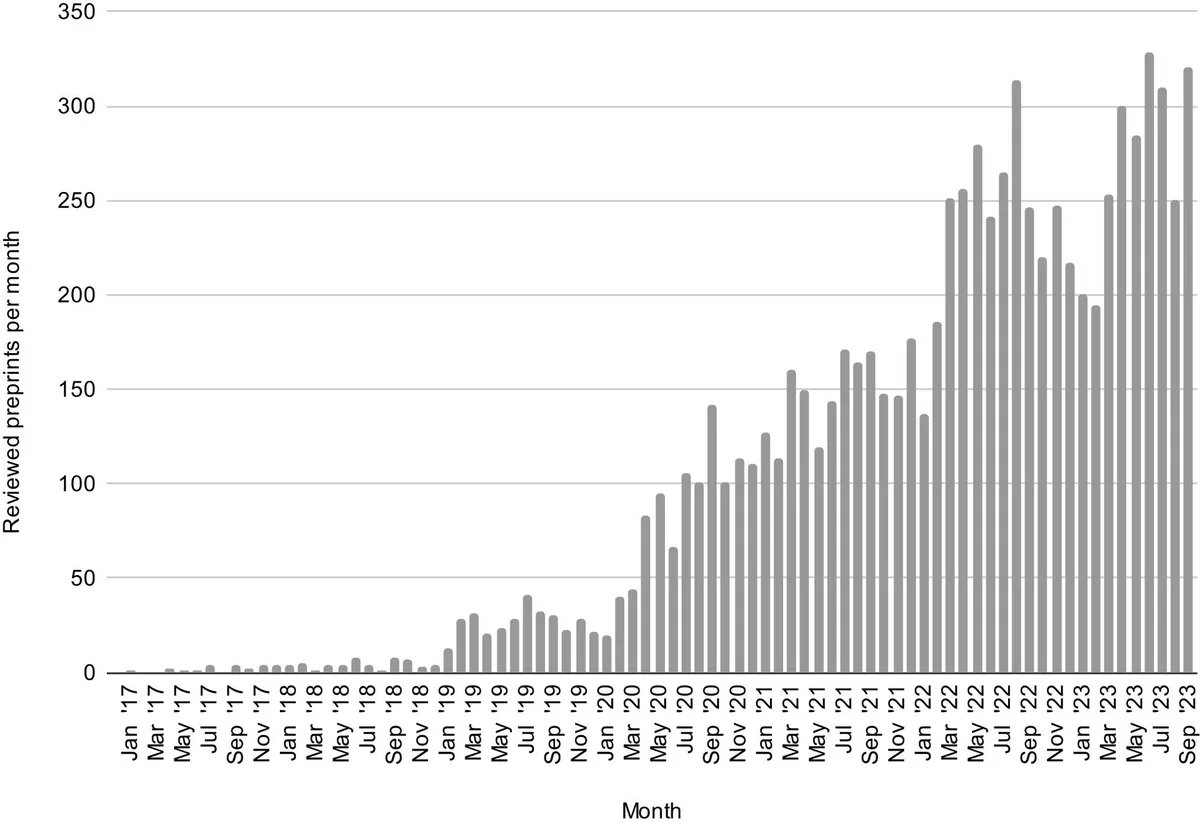
Preprint use exploded during the COVID-19 pandemic, when the pressure to share findings fast collided with the public's sudden appetite for real-time science news. Ratcliff's point is that the label "preprint" alone did little to communicate the uncertainty involved. Readers needed the tentativeness spelled out in plain language, not flagged with a term that means little to most people outside a lab.
What this means for you as a reader
A preprint is a claim, not a verdict. Reading one well means treating it the way a careful reader treats any unverified report: consider the source, check the scale of the evidence, and note explicitly what the authors say remains unknown.
The habits that help you evaluate a preprint are the same ones that help with published research generally. A result described in absolute terms, on a defined sample, with clearly stated caveats, is worth more than a headline-friendly summary stripped of all three. If you want the deeper mechanics behind those checks, the gap between a "significant" result and a meaningfully large one is its own subject, and so is the distinction between a study that shows correlation and one designed to test causation.
What remains unsettled is not whether preprints have value. It's how to communicate their preliminary status in a way that actually changes how people read them, since simply attaching the label hasn't done that job on its own. That is a communication problem as much as a scientific one, and it isn't solved yet.