Choosing a research method starts with the question, not the technique. As Merriam-Webster puts it, to choose is to pick one option from several alternatives — and in research methods in psychology, the alternatives differ in what they can honestly claim. An experiment can support a causal statement. A survey can describe what people think. Neither can do the other's job.
The core rule is simple: the method must fit the question. Ask "does X cause Y?" and only a design where the researcher controls X can carry the weight. Ask "how do people experience Y?" and a controlled trial would answer something else entirely. This guide walks through the main families of design and the claims each one licenses.
A useful habit, before anything else, is to write the question as a sentence with a blank in it. "Does ___ reduce exam anxiety?" "What do first-year students believe about ___?" The blank tells you what you must manipulate, measure, or simply observe — and that choice is the method.
What question are you actually asking?
Research questions come in three broad shapes. Descriptive questions ask what is happening: how common a behaviour is, what people believe, how a group changes over time. Relational questions ask whether two things move together: whether students who sleep more report better concentration. Causal questions ask whether changing one thing changes another.
Each shape points to a different design. Descriptive questions suit surveys and observational studies. Relational questions suit correlational designs. Causal questions, in principle, suit experiments — though in psychology the practical limits are real, because researchers cannot ethically assign people to poverty, trauma, or years of stress to see what follows.
The honest starting move is to decide which shape your question has. Many published disputes are really disputes about question shape: one team ran a causal question with a correlational design, and the argument followed. Our analysis suggests most method mistakes trace back to this single step, skipped in a hurry to start collecting data.
Experiments: when you can assign
An experiment is a design in which the researcher decides who gets what. Participants are assigned to conditions — a treatment and a control, or several doses of an intervention — and outcomes are measured afterwards. Because assignment is under the researcher's control, differences between groups can be attributed to the manipulation, provided the assignment is done properly.
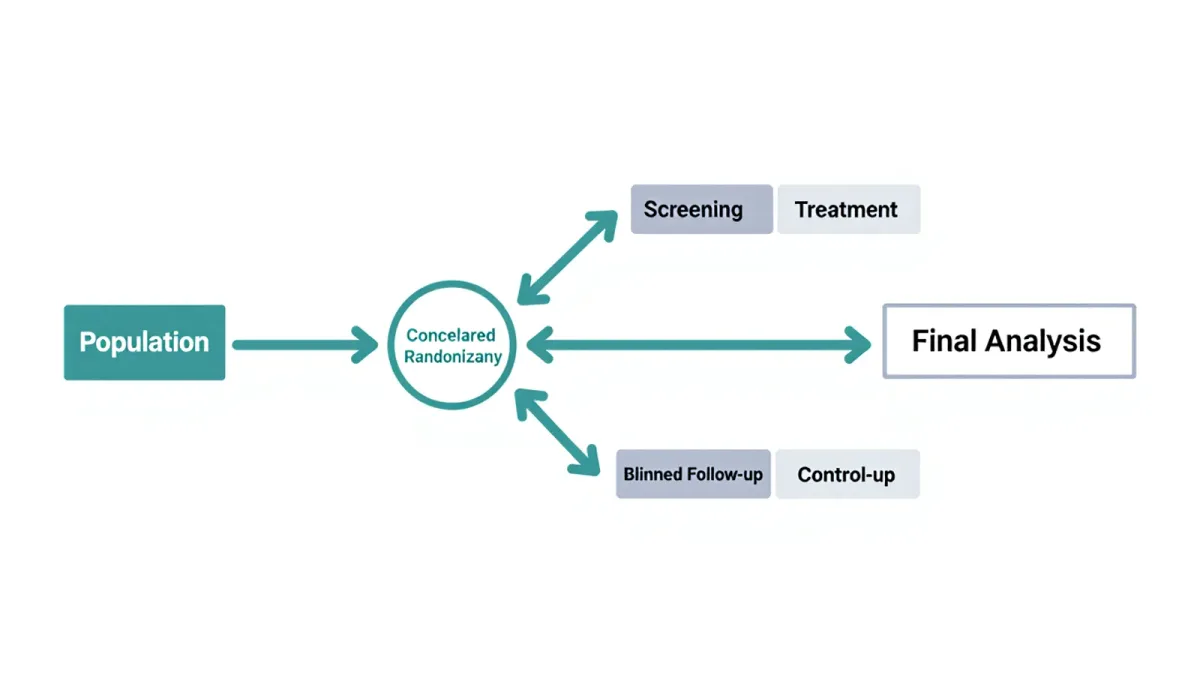
The machinery matters more than the label. Random assignment spreads the differences people bring with them — motivation, mood, prior knowledge — evenly across groups, so the groups are comparable before the treatment starts. Blinding keeps participants and, where possible, the people measuring outcomes from knowing who got what, so expectations do not leak into the results. These details are unglamorous, but they are what make the causal claim stand. We cover the mechanics in Randomization and Blinding: The Boring Machinery Behind Trustworthy Trials.
Experiments answer "does this cause that, under these conditions?" They do not automatically answer "does this cause that in everyday life?" A lab task with 40 undergraduates and a five-minute manipulation is a narrow window. The setting, the sample, and the duration all limit how far the finding travels — and the limitations paragraph, not the abstract, is where a careful reader checks that.
Observational designs: when you cannot assign
Much of psychology concerns things no one can or should manipulate. For those questions, researchers observe: they measure what people already do and look for patterns. Cohort studies follow groups over time. Case–control studies compare people who have a condition with people who do not. Cross-sectional studies take a snapshot at one moment.
These designs can find associations, and good ones can rule out some rival explanations. What they cannot do, on their own, is prove cause. People who choose a behaviour differ from people who do not in many ways besides that behaviour, and some of those differences — not the behaviour — may drive the outcome. This is the correlation problem, and study design is what decides how much of it a paper can address. We unpack the logic in Correlation Is Not Causation: How Study Design Decides the Argument.
Longitudinal designs — measuring the same people before and after — strengthen an observational claim, because the cause can be shown to come before the effect. But timing alone does not settle it. Confounding, the third variable sneaking in behind the scenes, remains the observational researcher's permanent companion.
Surveys and self-report: what people say is not always what people do
Surveys are the workhorse of descriptive research. They are fast, scalable, and the only practical way to learn what large numbers of people believe or remember. They are also the method readers most often over-trust.
Three problems recur. Sampling: who answered may not resemble who the findings are about. Wording: small changes in a question can shift answers. And the gap between saying and doing: self-reports of behaviour track actual behaviour imperfectly, sometimes badly. The headline number from a poll is usually the smallest part of its uncertainty. We treat these issues in The Margin of Error Is the Least of a Survey's Problems.
Use a survey when the question is about beliefs, attitudes, or self-described behaviour — and say so plainly in the write-up. A survey cannot establish that the behaviour happens as described.
Qualitative and mixed approaches: depth versus breadth
Interviews, focus groups, and ethnographic observation answer questions surveys cannot: why people act as they do, what a concept means to them, how a process unfolds in context. A well-run qualitative study with a dozen participants can generate hypotheses and explain mechanisms that a thousand-person poll would miss entirely.
The trade-off is generality. Small, purposively chosen samples are not designed to represent a population, and a qualitative finding should not be read as a prevalence figure. The strongest projects mix methods: qualitative work to find out what matters, quantitative work to measure how much.
What this means for your next study
Practical steps, in order. Write the question with a blank in it. Decide whether the blank is something you can ethically and practically control. If yes, and the question is causal, design an experiment — and budget for enough participants, because small studies produce misleading effects, as we explain in Underpowered Studies Find Too Much, and Too Big. If no, choose the strongest observational design available and be explicit about the causal limits.
Then check the claim you plan to make against the design you have chosen. A correlational study supports "X is associated with Y." An experiment supports "X caused Y in this setting, with this sample." Neither supports the sentence writers most want to print. Reading the methods section first, before the conclusions, is the cheapest quality check available — a habit worth keeping, along with a list of which findings later held up when others tried them again, as the field learned the hard way during its replication reckoning (The Replication Crisis, Explained: What Broke, and What Got Rebuilt).
What the evidence across these design families establishes is a division of labour: no single method answers every question, and each earns only the claim its design can carry. What remains unknown, in any individual study, is whether the finding survives a different sample, a different setting, or a second team. The method you choose determines which of those tests your work will be ready for.