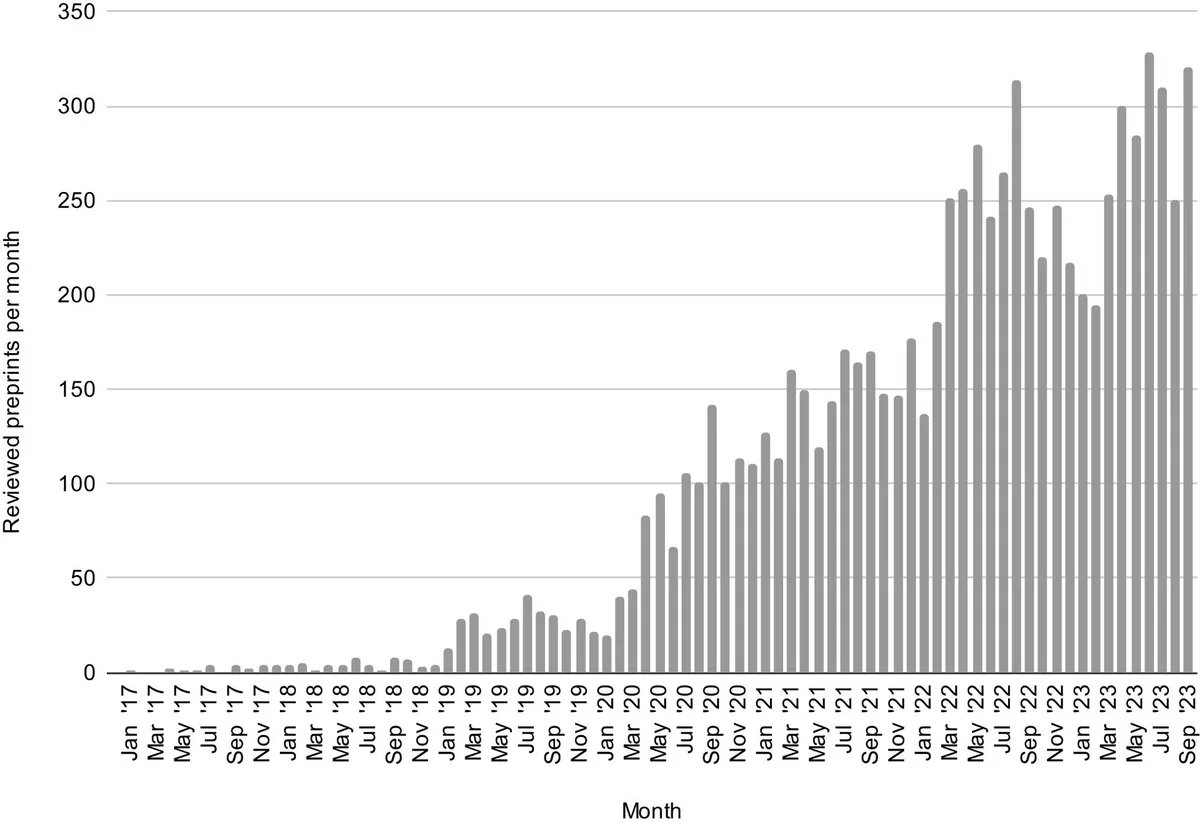
A preprint is a complete manuscript posted to a public server — arXiv, bioRxiv, medRxiv and their siblings — before any journal has accepted it. No editor, no reviewers, no acceptance letter. It is citable, it carries a DOI, and it can influence other researchers, journalists and policymakers immediately. By the early 2020s this had stopped being a fringe habit: during the COVID-19 pandemic, tens of thousands of manuscripts a year flowed through medRxiv alone, and in physics the arXiv server, founded in 1991, has been the field's de facto record for decades. The question for any reader is no longer whether to take preprints seriously, but how seriously.
This explainer covers research methodology, not medical or policy advice.
What does a preprint actually guarantee — and what doesn't it?
Posting guarantees authorship and priority: the community can see who reported a result first, and the timestamp is tamper-resistant. It guarantees availability: data and methods are on the table for others to inspect, attack or build on. It guarantees nothing about accuracy. Peer review is imperfect, but it is a documented filter — an editor checked the manuscript against the journal's scope, and typically two to four experts read it closely. A preprint has passed none of that. The authors alone are responsible for what is there, which is why the standard disclaimer on preprint servers matters: the work is unreviewed and should not guide clinical practice.
Where did the system come from?
Preprinting in physics began with arXiv in 1991, started by Paul Ginsparg at Los Alamos National Laboratory as an email bulletin that grew into the discipline's main channel. Biology resisted for two decades, largely because journals enforced the 'Ingelfinger rule' — named for a former New England Journal of Medicine editor — under which prior public release could bar publication. The dams broke with bioRxiv in 2013 and medRxiv in 2019, and by 2020 the pandemic turned them into the fastest-moving literature in biomedicine almost overnight.
Do journals treat a preprint as prior publication?
Overwhelmingly, no longer. Most major publishers state explicitly that preprint posting does not count as prior publication and does not disqualify a manuscript; many allow authors to update the preprint after acceptance with a link to the final version. Funders followed: several require or encourage grantee preprints, and review panels in some fields now accept them as evidence of productivity. The residual disputes are about licensing and about whether press coverage of a preprint — not the posting itself — amounts to publicity that journals once tried to control. In practice the Ingelfinger-era taboo has largely collapsed, and a manuscript's public life now typically begins before its journal life.
How often do preprints change on the way to publication?
Studies that matched preprints to their eventual published versions give a fairly consistent picture: the large majority of posted preprints are eventually published in some form, and most changes between preprint and journal version are modest — clarifications, added analyses, softened claims. But the exceptions are instructive. Analyses in the COVID-19 literature found that a minority of preprints were never published, and a minority changed materially, sometimes in the direction of weaker conclusions. Because the preprint version stays online with its original date, a reader who cites the preprint rather than the final paper can end up propagating a claim the authors themselves walked back. Version discipline is part of preprint literacy.
How strong is the evidence on preprints' scientific quality?
Direct comparisons are methodologically hard — published papers have been through revision, so any quality gap confounds the filter with the revision. What the literature does support is narrower and replicated across servers: screening studies during 2020 found that a substantial fraction of COVID-era medRxiv preprints had issues a careful reader would flag, from missing controls to overreaching abstracts, while the majority were sound work in progress. Survey data from the publishing-research community consistently show most researchers view preprints positively and a large minority read them regularly. The honest summary: preprints are neither a disaster nor a shortcut to truth; they are raw literature, with raw literature's error rate, visible in real time.
When is citing a preprint reasonable?
Three situations are widely accepted in practice. First, in fast-moving fields where the preprint is the only version — much of machine learning, where conference deadlines rather than journals set the rhythm, and arXiv posting is standard. Second, for methods and data: a dataset or protocol posted early can be used and credited even while the analysis matures. Third, as a clearly labeled 'not yet peer reviewed' citation, which is how careful journals and journalists handle it. What remains risky is treating a single preprint's headline claim as settled — especially when it contradicts reviewed work.
What would improve the picture?
Several mechanisms are already visible. 'Review commons' models — where a review happens at the preprint stage and travels with the paper to journals — are operating through initiatives associated with EMBO and other publishers. Open peer-review reports posted beside preprints give readers the filter without the delay. Journals increasingly accept preprints directly by transfer. The signal to watch is whether reviewing-at-posting becomes routine; if it does, the sharp line between preprint and publication will blur, and the burden will shift to readers checking whether a given manuscript carries review stamps or stands alone. Either way, the direction of travel is clear: since 2020 the preprint has moved from exception to expectation in much of science, and the working rule for every reader is to match the weight they give a claim to the filtering it has actually passed through.